 DUKA WORLD
Four in the morning
The working day in a baklava house starts before anyone would choose to be awake, for reasons that are entirely practical.
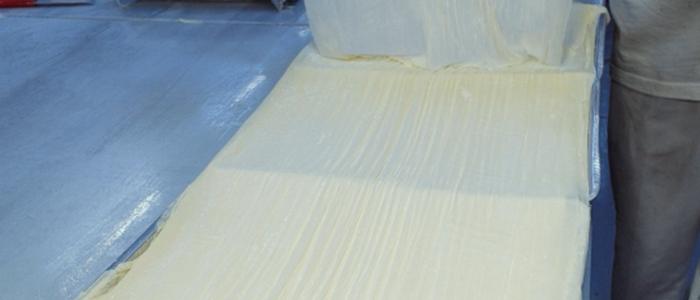
The dough is mixed at four. Not as a tradition, not for atmosphere, but because everything downstream depends on it and the chain cannot be started later without something being compromised at the other end.
Dough needs to rest. A freshly mixed dough is tight and elastic and fights the pin; left alone, the gluten relaxes and the same dough will stretch to translucency without tearing. That rest cannot be hurried. If you want sheets rolled by mid-morning, you mix before dawn.
The order of the day
Mixing first. Then resting, then dividing into balls, then the long slow work at the boards. Rolling is the bottleneck and the skill: a person who has done it for twenty years will produce a better sheet faster than a person who has done it for two, and there is no shortcut that closes the gap.
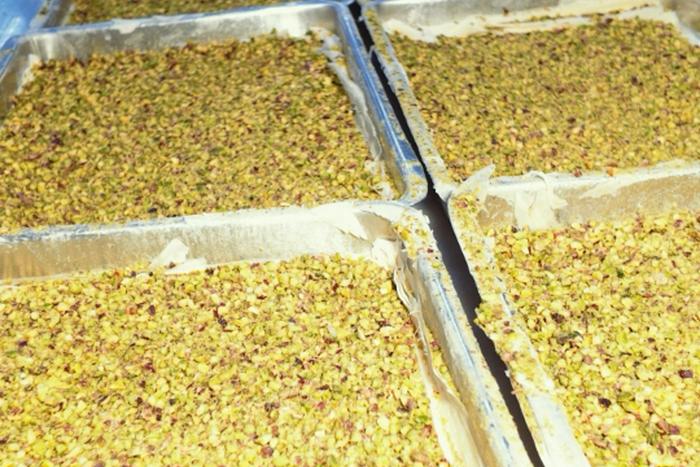
Pistachio is milled while the dough rests, because ground nut starts losing colour and aroma immediately and nobody wants it sitting. Trays are built through the late morning. Baking runs into the afternoon. Syrup goes on hot, which means someone is standing over a hot tray with a ladle at the end of a long shift, making a judgement that will decide whether the day's work was worth doing.

What the hours are actually for
Two things. The first is the rest, which is a chemical fact about dough and not negotiable. The second is heat — in a southeastern Turkish summer, a workshop is a difficult place to be by noon, and pastry behaves badly in it. Butter softens, dough dries, and the person doing the rolling is fighting the room as well as the material. Starting early is how you get the delicate work done before the building becomes an oven.
There is a third reason that is less often stated, which is that the finished product has somewhere to be. A tray baked in the afternoon is cool by evening, frozen overnight and on a pallet the next morning. Push the start of the day back by four hours and that whole sequence slides into a second day.
The rest cannot be hurried. If you want sheets rolled by mid-morning, you mix before dawn. Everything else in the day follows from that.
The people
A baklava workshop is not a bakery with a pastry section. The skills are specific and they are learned by repetition next to someone who already has them: how much flour to dust so the sheet does not stick but does not dry, when to stop rolling, how heavy the butter should be, where in the tray the nut layer wants more. None of that is written down in a way that transfers.
Which means the constraint on a good baklava house is not equipment. Ovens can be bought. Mills can be bought. What cannot be bought quickly is a roomful of people who have done this long enough to judge a sheet by feel, and that is why the firms that are good at it tend to be old, family-run and located in places where the skill is common.
What automation has and has not taken
Plenty has been automated, sensibly. Mixing, sheeting for some product lines, syrup dosing, sealing, freezing, palletising. These are steps where machine consistency beats human variability, and there is no romance in doing them by hand.
What resists automation is the judgement steps: the roll, the assembly, the scoring, the bake, the syrup. Each involves reading a material that behaves differently depending on humidity, flour batch and room temperature. Machines can be made to do them, and the products that result are perfectly edible — they are simply not the same product, and the difference is visible on the cut face.
Why any of this reaches the customer
It reaches the customer as texture. A hand-rolled sheet is thinner where it matters and slightly uneven, and that unevenness is why the layers separate rather than fuse. The shatter that people describe when they talk about good baklava is the physical trace of somebody having made a hundred small decisions about a piece of dough at six in the morning.
It also reaches the customer as cost. A workshop that starts at four and rolls by hand carries a labour bill that a machine line does not. There is no way to have the first thing without the second, and a producer claiming both is claiming something that does not exist.
The twelve production stages, with photographs of each, are set out on The craft page.
Seasonality inside the workshop
The rhythm changes across the year. In the run-up to Ramadan and Eid the floor runs at capacity and the constraint becomes people rather than ovens — you cannot hire a skilled roller for six weeks. Producers manage it by building order books months ahead and by shifting product mix towards lines that are quicker to assemble.
Summer brings a different problem. Heat makes butter soft and dough dry, and in a southeastern Turkish August the working window for delicate assembly narrows to the early morning. Workshops respond by starting earlier still and by moving the heaviest rolling work to the coolest hours.
What a visitor notices
The quiet, mostly. A baklava floor is not a noisy place: there is the low sound of mixers, the intermittent scrape of a pin on a board, and very little conversation during the rolling. People work in a rhythm that conversation interrupts, and the skilled stations tend to be silent.
The second thing is how much of the space is given to cooling and cold storage rather than to production. In a modern operation the ovens occupy a surprisingly small footprint; the blast freezer, the holding freezer and the packing area take far more, because that is where the product's commercial life is actually created.
Why the family structure persists
Skills transfer through proximity and repetition, and both are easier inside a family than across an employment contract. A child in a baklava household absorbs the judgement calls for years before ever being taught them formally, which is why so many of the long-established houses are still run by descendants of the people who founded them. It is not sentiment; it is the cheapest available training programme.