 DUKA WORLD
What baklava actually is, and what it is not
Everyone recognises it. Far fewer people can say what separates a good tray from a bad one — or why two pastries that look identical can cost three times apart.
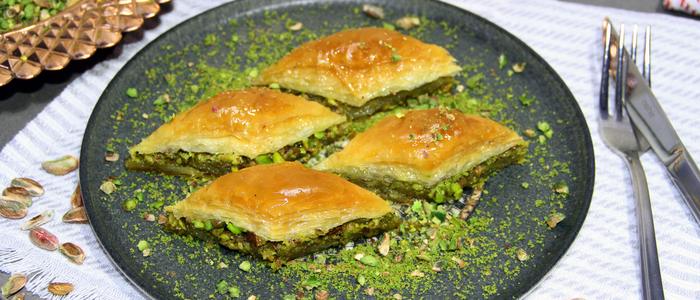
Baklava is a layered pastry made from sheets of unleavened dough, brushed with fat, packed with ground nuts, baked, and finished with sugar syrup. That sentence is accurate and almost useless. It describes a supermarket tray that costs a few euros and a Gaziantep tray that costs twenty times as much, and it explains nothing about why anybody would pay the difference.
The interesting part is in the variables. How thin is the sheet. How many of them are there. What fat went between them. What nut, at what grade, ground when. How hot the syrup was and how hot the tray was when they met. Each of those is a decision, and each one moves the finished pastry somewhere on a scale between forgettable and the reason people fly home with a box in their hand luggage.
The sheet
The dough is called yufka in Turkish and phyllo in the Greek-derived name most of the world uses. It is flour, water, a little salt, sometimes a little starch, and nothing else. No yeast, no fat in the dough itself. What makes it remarkable is how far it is pushed: a competent baklava maker rolls a sheet until you can read newsprint through it, using a long thin pin called an oklava rather than the short handled rolling pin most European kitchens own.
Machine-rolled phyllo exists and is perfectly serviceable. It is also, invariably, slightly thicker and more uniform than hand-rolled sheet, because a machine cannot feel where the dough is thinning and back off. That uniformity is why industrial baklava tends to eat dense rather than shattering. The layers fuse instead of separating.

The fat
Between the sheets goes fat, and this is the single most reliable indicator of what you are buying. Traditional baklava uses clarified butter — butter with the water and milk solids removed, so it can be brushed on hot and baked without burning or turning the pastry soggy. It is expensive, it is what carries the flavour, and it is the reason good baklava should be eaten at room temperature rather than cold. Chill it and the butter firms up and mutes everything.
The alternatives are margarine, vegetable shortening and palm fat. They are cheaper, they are more stable on a shelf, and they are detectable. A baklava made on palm fat has a waxy finish on the lip that butter does not leave. If a supplier will not tell you which fat they use, you already have your answer.
A baklava made on palm fat leaves a waxy finish on the lip that butter does not. If a supplier will not name the fat, you already have your answer.
The nut
Pistachio and walnut dominate, with hazelnut and almond appearing regionally. Pistachio is the premium: it is more expensive, it gives the green that photographs well, and in Turkish baklava it usually means pistachio from the Gaziantep region in the southeast — smaller and greener than most commercial pistachio, with a higher oil content that survives baking.
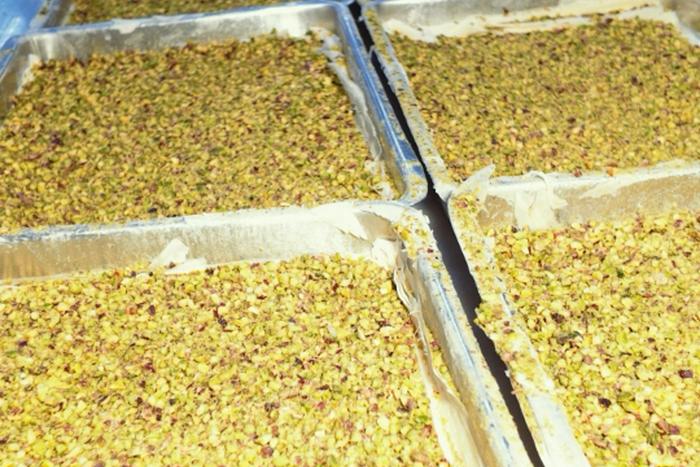
Grade matters more than variety. Whole first-grade kernels milled on the morning of production behave differently from pre-ground pistachio bought by the sack. Ground pistachio starts losing its colour and its volatile oils within hours; a tray built on nut that was milled a week ago in a different building will look duller and taste flatter, and no amount of syrup fixes it.
The syrup
Sherbet — şerbet — is sugar, water, and usually a little lemon to stop it crystallising. It is poured over the tray after baking, and the temperature relationship between the two is one of the small pieces of craft knowledge that separates a baklava house from a bakery that also makes baklava. Get it wrong and the pastry either goes dry or collapses into sweetness.
The quantity of syrup also sets how sweet the finished product is, and this is where regional preference and export reality collide. Baklava made for a Turkish domestic palate is often sweeter than a Northern European or Japanese buyer wants. A producer selling into several markets either adjusts, or accepts that some markets will find the product cloying.

What separates the cuts
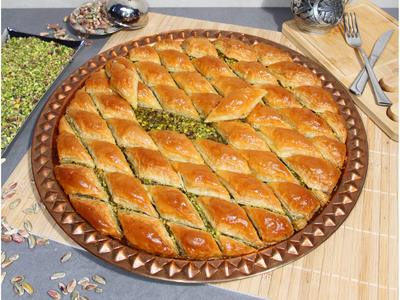
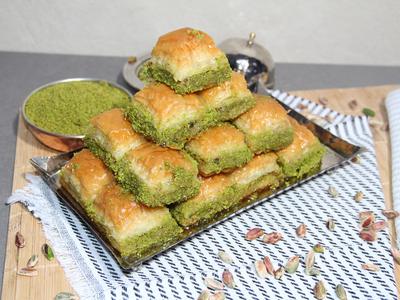
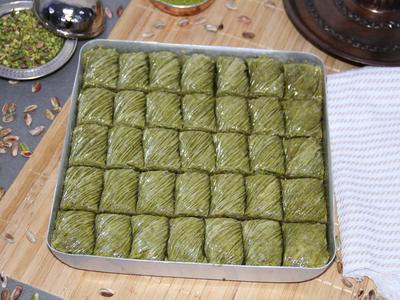
Turkish baklava is not one product but a family of them, and the differences are not decoration. The cut sets the portion size, the ratio of crust to filling, and how the piece survives on a counter. A classic diamond has a high proportion of edge, so it eats crisp. A rolled form — a curl, a burma, a sarma — has the filling enclosed, so it holds its shape through freezing and handling far better than an open cut.
Cream-filled forms such as şöbiyet add kaymak, a thick clotted cream, and change the product entirely: richer, more perishable, and far more dependent on an unbroken cold chain. The cold pistachio pieces, which are never baked to colour at all, are a third category again — almost entirely nut, barely sweetened, and visually nothing like the golden thing most people picture.
What it is not
Baklava is not a single national dish with a single correct recipe. Layered nut pastries appear across the former Ottoman world and beyond it, and versions in Greece, Lebanon, Armenia, Iran, the Balkans and the Levant differ in nut, syrup, spicing and thickness. The Turkish tradition is distinctive in its thinness of sheet and its use of pistachio, and Gaziantep's version carries protected status; that is a claim about a specific product, not about who invented the category.
It is also not a fragile luxury that cannot travel. Properly made and properly frozen, it survives a container voyage better than almost any other pastry, because the thing that destroys it is moisture and the thing that preserves it is cold. That is the whole commercial argument for the category, and it is why a pastry invented for palace kitchens now ships by the pallet.
Written for buyers new to the category. For the specification of any individual line, see the product pages; for the twelve production stages, see The craft.
How to taste one properly
Take a piece at room temperature, never straight from a chiller, and look at the cut face before you eat it. You are checking three things: whether the layers are visibly separate rather than compressed into a single mass, whether the nut seam runs evenly from edge to edge rather than pooling in the middle, and whether the base has absorbed syrup without turning to paste. All three are visible in good light and none of them can be faked by a photograph.
Then listen. A properly made baklava is audible — the first bite should produce a distinct dry crack rather than a soft yield. If it bends before it breaks, the pastry has taken up moisture, which means either it was made too long ago, it was frozen badly, or it was thawed in the open air. None of those are recoverable faults.
Finally, notice what your mouth does afterwards. Clarified butter melts at close to body temperature and clears cleanly; vegetable shortening does not, and leaves a faint coating on the lip and palate that persists for a minute or two. That single sensation separates the two halves of the category more reliably than any ingredient declaration.
The mistakes buyers make first
Three recur. The first is buying on appearance from a photograph, which flatters almost everything and reveals almost nothing — a tray dusted generously with pistachio after baking looks identical to one built with a generous seam inside. The second is assuming that all Turkish baklava is broadly equivalent, when the spread in quality within a single city is enormous.
The third, and the most expensive, is specifying the wrong product for the route. An open cut with a delicate crust will arrive in worse condition than a rolled form after the same journey, and a cream-filled line specified for a market with an unreliable cold chain is a claim waiting to be made against you. Matching the product to the logistics is a decision to take before the tasting, not after it.