 DUKA WORLD
The pistachio gardens of the world
A tree that wants hot dry summers, cold winters and very little water grows in a narrow band across the planet — and each garden gives a different nut.
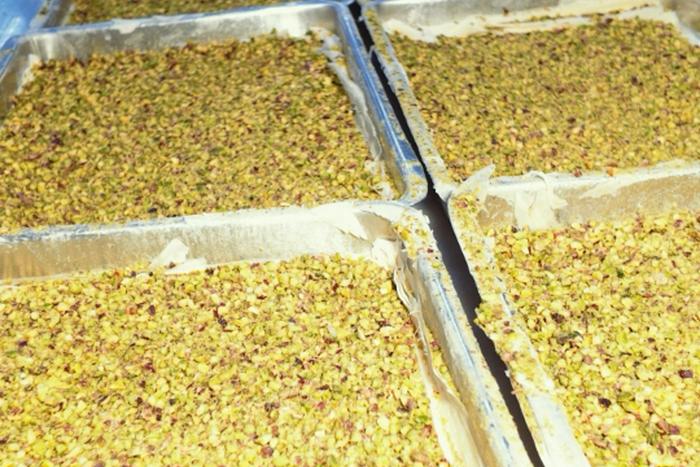
Pistacia vera is a fussy tree with unusual demands, and those demands draw a map. It wants long, hot, dry summers to fill the kernel and split the shell. It wants a genuinely cold winter to break dormancy. It does not want humidity, which invites disease into a crop that hangs in clusters. And it tolerates poor, stony, saline soil better than almost any other commercial nut, which is why it thrives in places where little else will.
Put those conditions together and you get a band that runs from the Iranian plateau through eastern Turkey and the Levant, with outposts around the Mediterranean and a large modern transplant in California. Every garden in that band produces a recognisably different nut, and if you buy pistachio in quantity the differences are commercial rather than academic.
Iran
Iran is the historic heartland. The tree is native to this broad region, and the orchards around Rafsanjan in Kerman province have been the reference point for the crop for a very long time. Iranian pistachio is typically sold by shape — the long, slim Akbari and Ahmad Aghaei types, the rounder Fandoghi, the large Kalleh Ghouchi — and the naming system tells you that this is a market where the eating nut, not the ingredient, sets the grades.
Water is the constraint. Pistachio is drought-tolerant compared with almond, but 'drought-tolerant' is relative, and sustained groundwater depletion across the Iranian plateau has pushed orchards and yields around in ways that show up in world pricing.
Turkey
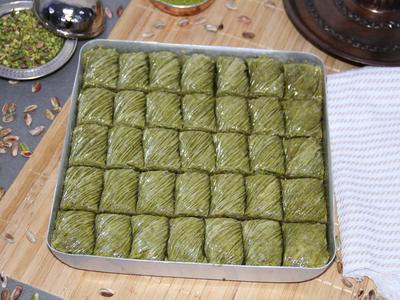
Turkish pistachio is grown mainly in the southeast, around Gaziantep, Şanlıurfa and Adıyaman, with a distinct larger-kernelled crop around Siirt. The Antep type is small, intensely green and high in oil — qualities that make it mediocre as a snack nut and superb as an ingredient. That is the crucial point for anyone buying baklava: the Turkish pastry tradition is built on a pistachio selected for colour and oil rather than size.
Turkey consumes most of what it grows. A large domestic confectionery and pastry industry absorbs the crop, which is why Turkish pistachio is a less visible commodity on world markets than the Iranian or Californian crop despite the volumes involved.
California
The Californian industry is modern, deliberate and enormous. Pistachio was planted commercially in the Central Valley from the middle of the twentieth century, built almost entirely around a single female variety, Kerman, pollinated by a male called Peters. That genetic narrowness makes the orchards uniform and the harvest mechanisable — trees are shaken, nuts are caught, hulled and dried within hours, which is why Californian pistachio has very low aflatoxin rates and excellent shelf stability.
What it does not have, for an ingredient buyer, is the deep colour of the Antep type. Californian pistachio is a magnificent snack nut. In a pastry where the green is half the product, it behaves differently.
Sicily
On the slopes of Etna, around the town of Bronte, pistachio grows in volcanic rock. The trees are planted in lava soil, harvested by hand because the terrain refuses machines, and picked in alternate years — the crop is deliberately rested in the off year to concentrate the following harvest. The result is a small, very green, intensely flavoured nut with protected designation status and a price that reflects all of the above.
Bronte pistachio is a garnish and a flavouring, not a bulk ingredient. If a product claims Bronte pistachio throughout at a commodity price, something is wrong with the claim.
Bronte pistachio is harvested by hand from lava soil in alternate years. It is a garnish and a flavouring. If a product claims it throughout at a commodity price, check the claim.
Greece
Aegina, the island within sight of Athens, produces a protected pistachio with a reputation out of proportion to its volume. The volcanic soil and the maritime climate give a nut that is sweeter and softer than the continental crops. Greek production also runs in Attica and the Peloponnese, largely into the domestic market and the tourist trade.
Spain, Australia and the newcomers
Spain has planted pistachio hard over the past two decades, particularly in Castilla-La Mancha, where the continental climate suits it and where it offers dryland farmers an alternative to cereals. Australia has a smaller industry in the Murray valley, with the useful commercial property of harvesting in the opposite half of the year to the northern hemisphere.
Syria was historically a significant producer, with orchards around Aleppo that gave the nut one of its older common names. Afghanistan has wild and cultivated stands. Both have been disrupted in ways that have nothing to do with agronomy.
Why any of this matters to a buyer
Pistachio is usually the largest single input cost in a nut pastry, and it is an alternate-bearing crop — the tree naturally produces a heavy year and a light year — so supply and price swing more than most commodities. A supplier who quotes a fixed pistachio price a long way forward is carrying that risk somewhere, and it is worth knowing where.
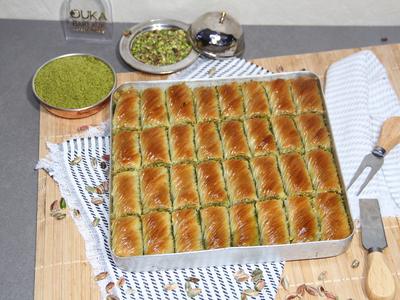
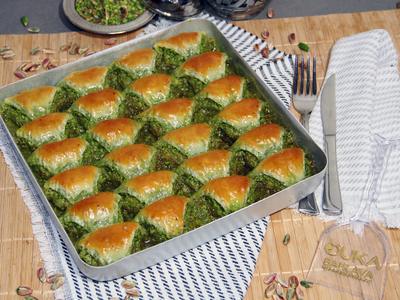
Origin also determines what the finished product looks like. A baklava built on Antep pistachio has a green that a Californian-built one does not, and vice versa a Californian nut delivers a consistency and a food-safety record that is hard to match. Neither is better in the abstract. They are different tools, and a producer should be able to tell you which one is in the tray and why.
Crop volumes, prices and rankings move year to year with weather and the alternate-bearing cycle. Treat any fixed figure with suspicion and check current customs and trade data before building a plan on it.
Alternate bearing, and what it does to a price list
Pistachio trees do not produce evenly. A heavy crop exhausts the tree's reserves, so the following year is light, and orchards across a region tend to synchronise into the same rhythm. The swing is large enough that a producer's input cost can move substantially between one season and the next through no change in quality, sourcing or contract.
For a buyer this has one practical consequence. Any supplier offering a fixed pistachio-based price a long way forward is absorbing that risk somewhere — in a hedge, in a margin buffer, or in a quiet plan to reduce the nut content if the market turns. It is a fair question to ask which.
Water, and the constraint nobody talks about
Pistachio is more drought-tolerant than almond, which is why it has been planted heavily in places where water is the limiting factor. Tolerant is not the same as indifferent: yields respond to irrigation, and several of the world's major growing regions sit on aquifers that are being drawn down faster than they refill.
That is a slow-moving structural pressure on the crop rather than a next-season problem, but it is the reason new plantings keep appearing in places like Spain and Australia. Anyone building a long-term product around pistachio should understand that the map of where it grows is not fixed.
What to ask a supplier about origin
Ask for the growing region rather than the country, because within Turkey alone the Antep type and the Siirt type are different products for different uses. Ask whether the nut is bought whole or ground, and when it was milled relative to production. Ask what happens in a light crop year — whether the specification holds or the recipe quietly moves.