 DUKA WORLD
Gaziantep, and the belt of land that decides the flavour
A city became synonymous with a pastry because of what grows two hours away from it. That is not romance; it is agronomy.
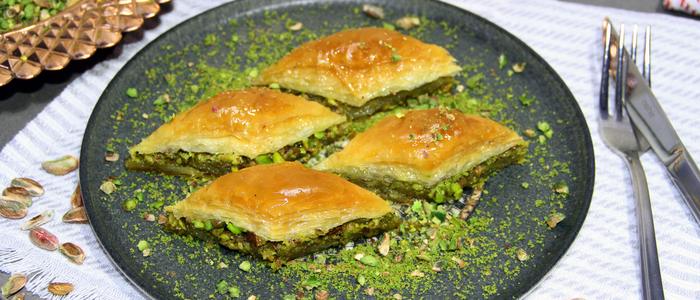
Gaziantep sits on a limestone plateau in the southeast of Turkiye, close enough to the Syrian border that the food of the two sides has more in common with each other than either has with Istanbul. It is an old city, it has been a trading city for most of its life, and for the last century or so it has been the place that people mean when they say Turkish baklava.
The reason is not that somebody in Gaziantep was cleverer than everybody else. It is that the plateau around the city is one of the few places on earth where Pistacia vera is genuinely happy, and a pastry tradition grew up in the presence of an abundant, cheap, extremely good local nut. Proximity did the rest.
What the land gives
Pistachio wants a long hot dry summer to fill and split the kernel, a real winter to break dormancy, stony free-draining soil, and not much water. The southeastern plateau supplies all four. The trees there are often old, frequently rain-fed rather than irrigated, and grown at densities that would look sparse to a Californian grower. Yields per hectare are modest by modern standards.
What those conditions produce is a small kernel with an unusually deep green colour and a high oil content. As a snack nut it is unremarkable — too small, too fiddly to shell. As an ingredient it is exceptional, because the colour survives grinding better than a paler nut and the oil carries flavour through a hot oven. The Antep type is, in effect, a pastry pistachio.
Why the pastry followed
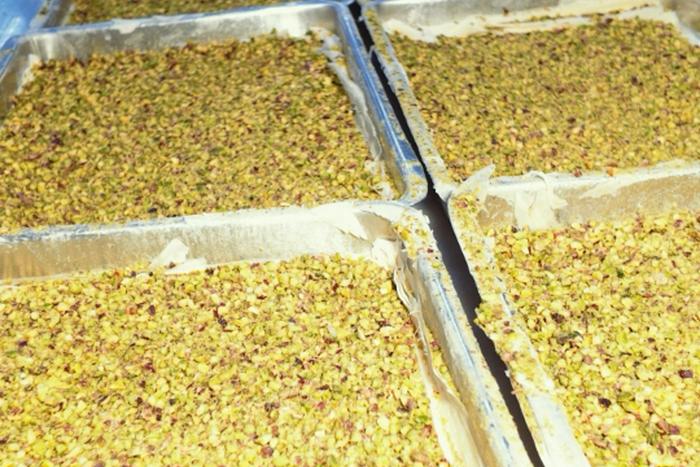
When a raw material is abundant and local, cooks use it lavishly, and lavish use becomes the regional style. Antep baklava is defined partly by how much pistachio goes into it — a seam thick enough that the green reads from across a room, not a scattering for garnish. The sheet is rolled exceptionally thin partly so that the nut, rather than the pastry, is the dominant sensation.
The syrup is correspondingly restrained. Where other traditions lean into sweetness, the Antep style pulls back, because burying an expensive pistachio in sugar wastes it. That single decision is why people who find other baklava traditions cloying often get on with the Turkish version.
When a raw material is abundant and local, cooks use it lavishly. Lavish use becomes the regional style, and the regional style becomes the definition.
Protected status
Antep baklava carries protected geographical indication, which means the name is legally tied to a defined product made to a defined method within a defined area. That is a narrow, specific protection. It does not say that Gaziantep invented layered pastry, and it does not stop anyone anywhere making excellent baklava. It says that if you sell something called Antep baklava, it has to actually be that.
For a buyer, the practical value of the designation is not the badge. It is that the specification behind it names things — the nut, the fat, the method — that a supplier has to meet. Ask for the same specificity from any supplier, protected or not, and you will learn more than the label tells you.
The neighbours
The pistachio belt does not stop at the Gaziantep city limits. Şanlıurfa and Adıyaman grow the same type. Further east, around Siirt, a different and much larger-kernelled pistachio is grown, prized for eating rather than for pastry. Across the border, the orchards around Aleppo were historically so significant that the nut is still called the Aleppo pistachio in several European languages.
Two hours north of Gaziantep, Kahramanmaraş sits at the edge of the same belt but with a different emphasis. The pistachio is available, but the defining local product is dairy: the Taurus foothills give a thick clotted cream, and the Maraş pastry tradition is built as much on that cream as on the nut. The two cities' ranges look different for the same reason their landscapes do.
What this means when you buy
Origin claims on pistachio are worth verifying, because the price gap between Antep-type nut and commodity pistachio is large enough to be worth lying about. The honest test is visual and olfactory rather than documentary: look at the cut face of a finished piece, where surface dusting cannot flatter, and smell it. Real fresh-milled Antep pistachio has a sweet resinous smell that survives baking.
It is also worth knowing that a producer can use excellent Antep pistachio badly. Buying the right nut and then grinding it a week early, or burying it under syrup, or baking it into oblivion, wastes the advantage entirely. The belt gives a producer the opportunity. What they do with it is a separate question, and it is the one worth asking.
Protected geographical indication is a legal instrument covering a named product from a defined area. It is not a ranking of regional traditions.
Why the trade concentrated in one place
Raw material explains part of it, but not why hundreds of specialist workshops clustered in a single city rather than spreading evenly across the growing region. The rest is the usual economics of a craft cluster: once enough skilled rollers, bakers and mill operators live in one place, it becomes cheaper to start a business there than anywhere else, and the labour pool deepens with every new workshop.
Guild traditions reinforced it. Skills passed through apprenticeship rather than schooling, which tied them geographically, and reputation attached to the city as much as to any individual house. A century of that produces what Gaziantep has now: a concentration of expertise that a competitor cannot replicate simply by buying the same equipment.
What the city does with the crop
Very little of the local pistachio leaves as a raw commodity. It is absorbed by the confectionery and pastry trade within the region, which is why Turkish pistachio is less visible on world markets than its production volume would suggest. A buyer sourcing raw Antep pistachio in quantity is competing directly with the pastry industry for it.
That internal demand also sets the grading. Because the largest customer is a pastry maker rather than a snack packer, the grades that command a premium locally are the ones that perform in a tray — deep colour, high oil, small size — rather than the large uniform kernels an export snack market would want.