 DUKA WORLD
Why pistachio is green, and why that green disappears
The colour is chlorophyll and anthocyanin, it is fragile, and almost everything a factory does to a pistachio makes it duller.

A pistachio kernel is green because it retains chlorophyll, which most seeds discard as they mature, and because it carries anthocyanin pigments that give the purplish skin and contribute to the depth of the colour underneath. The combination is unstable. Heat degrades it, light degrades it, oxygen degrades it, and time degrades it even in the dark.
This matters commercially because in a pistachio pastry the colour is doing a large part of the selling. A tray with a vivid green seam reads as generous and fresh; the identical tray with a dull olive seam reads as tired, whether or not it is. Buyers respond to it before they taste anything.
What makes a kernel green in the first place
Varieties differ. The small Antep-type kernels grown in southeastern Turkey are notably greener than the large Kerman kernels that dominate Californian production, and Sicilian Bronte pistachio is greener still. Within a variety, harvest timing matters: a kernel picked slightly early is greener and less sweet, one left longer is paler and fuller. Growers make that trade deliberately depending on whether the crop is destined for snacking or for confectionery.
There is also a simple physical factor. The greenest part of a pistachio is the interior; the skin is purplish-brown. Peeled kernels are greener than unpeeled ones, which is why high-end pistachio pastes and confectionery pistachio are sold peeled, and why peeled pistachio costs considerably more.

What destroys it
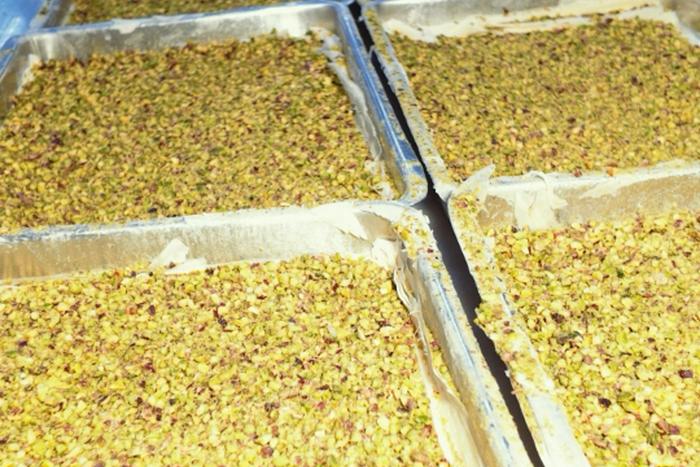
Milling is the first insult. Grinding ruptures cell walls, releases oil, and exposes an enormous new surface area to air. A whole kernel is relatively stable; ground pistachio begins oxidising immediately. Within hours the colour flattens and the aroma — which in fresh-milled pistachio is startlingly strong — fades to something generic.
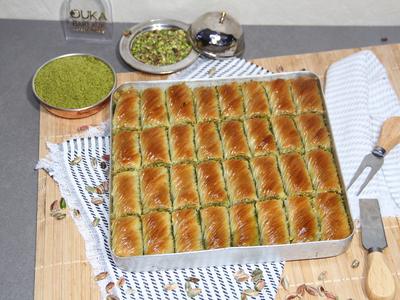
Heat is the second. Baking obviously applies heat, which is why the pistachio inside a baked baklava is duller than the pistachio dusted on top after baking. Producers work around this by using the coarse mill inside the tray, where colour is less visible, and reserving the fine mill for surface dusting applied late.
Storage is the third. Ground pistachio held in a warm room in a clear container under light will lose its colour in days. Held cold, dark and sealed, it holds for considerably longer — but never as long as a whole kernel.
A whole kernel is stable. Ground pistachio starts oxidising the moment it leaves the mill, and the aroma goes before the colour does.
The in-house milling argument
This is why producers who care about colour mill their own pistachio on the day of production rather than buying it pre-ground. It is not a romantic preference. Pre-ground pistachio bought by the sack has already spent days or weeks losing exactly the qualities you are paying for, and no process downstream recovers them.
It is also a cost decision that shows on a balance sheet. Whole first-grade kernels cost more than ground, in-house milling requires equipment and labour, and the practice consumes the nut faster because you cannot hold ground stock. A producer doing it is spending money to protect something a customer will notice without being able to name.
How to judge it
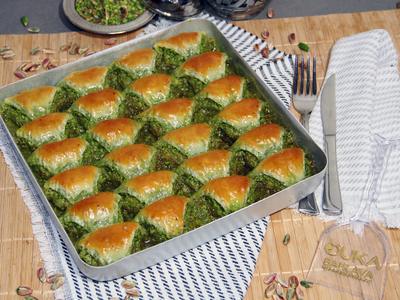
Look at the cut face rather than the surface. Surface dusting can be applied generously and late, and it flatters. The seam inside a cut piece tells you what the tray was actually built with: a vivid, slightly variegated green with visible kernel fragments suggests fresh-milled first-grade nut, while a uniform flat olive suggests something that has been sitting, or a cheaper grade, or both.
Smell it. Fresh-milled pistachio has a distinct sweet resinous aroma. If a tray smells mostly of butter and sugar with no nut character, the pistachio in it has given up whatever it had before it got there.
And be suspicious of a green that is too good. Colour additives exist and are permitted in some jurisdictions and not others, and an improbably uniform emerald is worth asking about. Real pistachio is not one flat colour; it varies kernel to kernel, and that variation is the tell.
Pistachio is a tree nut and a regulated allergen in every market covered on this site. Colour has no bearing on that; the declaration is required regardless.
Peeled, unpeeled, and what you are paying for
The greenest part of a pistachio is under the skin. Removing that thin purplish membrane — blanching and peeling — exposes the colour underneath and produces the vivid emerald that high-end confectionery uses. It also costs money, wastes weight, and shortens stability, because the protective skin was doing a job.
Most baklava does not use fully peeled pistachio throughout; it is too expensive at the volumes involved. What good producers often do is use unpeeled nut for the seam inside the tray, where the colour is less visible, and reserve peeled or finely milled nut for the surface where it will be seen. Knowing that lets you read a tray more accurately.
Storage, in practical terms
- Buy whole, not ground, wherever the process allows it.
- Mill on the day of use. Hours matter more than days.
- Hold ground nut cold, dark and sealed, and hold as little of it as possible.
- Keep it away from strong aromas. Nut oils pick up smells readily.
- Treat any visible oil separation as a signal that the stock is old.
The additive question
Colour additives in confectionery are permitted in some jurisdictions and restricted in others, and pistachio products are occasionally enhanced. The tell is uniformity: real ground pistachio varies in tone from fragment to fragment, and a perfectly even emerald across a whole surface deserves a question. So does a green that survives baking better than it physically should.
This matters beyond aesthetics, because a colour additive that is legal in one market may be unlisted or prohibited in another, and an undeclared one is a compliance failure rather than a style choice. Ask for the full ingredient declaration in writing, not just the headline list.
Grading, and what the names mean
Pistachio is graded by size, by whether the shell has split naturally, and by kernel condition. Larger counts per kilo command higher prices in the snack trade, which is the opposite of what a pastry maker wants — small, dense, deeply coloured kernels carry more flavour per gram and mill more evenly. A supplier quoting a premium snack grade for a baklava filling is either confused or selling you something you do not need.
Ask which grade sits in the seam and which sits on the surface. Good producers use different stock for the two jobs, and being told that a single grade is used throughout is usually a sign that nobody has thought about it very hard.