 DUKA WORLD
Kaymak: the cream that cannot travel
The richest pastries in the Turkish repertoire depend on a dairy product with a shelf life measured in days. That constraint shapes an entire regional cuisine.
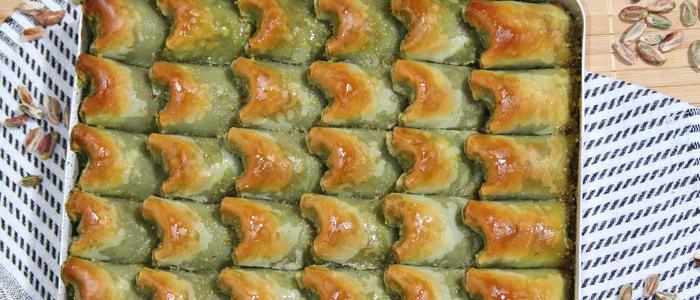
Kaymak is what happens when you take very high-fat milk, heat it slowly and at length, and let the fat rise and set into a thick blanket on the surface. It is skimmed off in sheets, and it is one of the richest dairy products anyone makes anywhere — closer in fat content to butter than to cream, with a texture between clotted cream and soft cheese.
It is also fragile. Kaymak has no preservation to speak of, it does not freeze well on its own, and it is at its best within a day or two of being made. Everything about the pastries built on it follows from that single fact.
Where it comes from
The best kaymak comes from water buffalo milk, which is dramatically higher in fat than cow milk and produces a firmer, sweeter, less sour result. Sheep milk is also used. Afyon, in western Anatolia, is the name most Turks associate with kaymak; the Taurus foothills around Kahramanmaraş are another traditional source, and the local pastry tradition grew up around the supply.
Buffalo herds are small, labour-intensive and geographically concentrated, which keeps kaymak expensive and local. You cannot scale it the way you can scale cow dairy, and a producer more than a short drive from the herds is buying something compromised.

What it does in a pastry
In şöbiyet, kaymak sits inside a pocket of phyllo alongside pistachio and goes into the oven. The cream does not melt away; it firms slightly and stays distinct, so the finished piece has three textures — crackling pastry, cool dense cream, and the granular nut. That contrast is the entire point of the product, and it is why şöbiyet is the piece that baklava enthusiasts order when they want to test a producer.
In the cold pastries — the Maraş roll, the palate cracker, the princess — the cream is never baked at all. It sits at the core of a roll or in a slab, and the pastry is there in a supporting role rather than a starring one. These are the products that read least like what an outsider expects baklava to be, and they are often the ones that convert people.
Kaymak does not melt away in the oven. It firms slightly and stays distinct, which is why a cream-filled piece has three separate textures instead of one.
The export problem, and its solution
A pastry that depends on a two-day cream is, on the face of it, unexportable. The solution is the same one that made the whole category exportable: blast freezing. Taken to minus eighteen within hours of production, the cream's water forms crystals small enough not to rupture the structure, and on controlled thawing it comes back close to where it started.
Close to, not identical. Freezing is a compromise with kaymak in a way it is not with a plain baked baklava, and any honest producer will say so. The closed forms — where the cream is fully enclosed by pastry — survive the cycle best, because the pastry buffers the cream from temperature swings and from the drying effect of a freezer. That is why the closed şöbiyet is the cream line most often specified for long routes.
How to handle it
Thaw cream-filled pastries slowly, in the carton, in a chiller overnight. Fast thawing pulls condensation onto the pastry and the crust never recovers. Do not refreeze anything that has come to room temperature. And serve cream pastries cooler than plain baklava — the cream is better a little cold, where the butter in a plain tray is better at room temperature.
On a counter, the closed forms hold longest. Open cream pastries dry at the exposed edge within hours under display lighting, which is a presentation problem before it is a food safety one. If a display has to run all day, the closed dome is the line to put in it.
Why it is worth the trouble
Cream-filled pastries are the highest-margin and the highest-risk part of the range. They cost more to make, they demand more of the cold chain, and they punish careless handling. They are also the products people remember, and the ones that justify a premium position for the whole range.
A producer who offers only plain baked baklava is offering the safe half of the category. A range that includes the cream lines is making a statement about what its cold chain can do — and a buyer who cannot keep that chain intact should say so early, because there is no point specifying a şöbiyet for a route it will not survive.
Cream-filled lines contain milk, a regulated allergen in every market covered on this site, alongside tree nuts and wheat.
How it is actually made
Milk is heated slowly for a long time, sometimes several hours, then left to stand and cool undisturbed. Fat rises and sets into a thick continuous layer on the surface, which is lifted off in sheets and often rolled. The process concentrates fat dramatically and develops a mild cooked-milk flavour that raw cream does not have.
Everything about it resists scale. It needs very high-fat milk, it needs time rather than equipment, and it cannot be rushed with heat without producing a grainy result. A dairy that wants to make more of it needs more animals and more hours, not a bigger machine.
Substitutes, and how to spot them
Industrial alternatives exist: stabilised whipping creams, vegetable-fat creams, and reconstituted dairy blends. They behave more predictably in a freezer and cost a fraction as much, and they are used widely in the cheaper end of the category. The difference is textural rather than visual — a real kaymak filling is dense and slightly waxy and holds its shape when cut, where a stabilised cream is lighter, airier and tends to compress under the knife.
If a cream-filled pastry is noticeably cheaper than its neighbours on a price list, the cream is where the saving almost always sits. Ask what is in it, by name, and ask whether it contains vegetable fat.
Specifying cream lines for a difficult route
If the destination cold chain is uncertain, specify closed forms over open ones, avoid the cold uncooked slabs entirely, and consider limiting cream lines to a small proportion of the first container while you learn how the route behaves. It is far better to discover a weak link on four pallets than on a full load.