 DUKA WORLD
Forty layers, and why anybody counts
Layer count is the most quoted number in baklava and the least verified. Here is what it actually controls.
Every baklava producer will tell you a layer count. Thirty, forty, sixty, a hundred. The number is offered as a proof of quality, it is almost never checked by the person hearing it, and on its own it means very little. What the number stands in for is something real, but it is worth understanding what that is before you use it to compare suppliers.
What layers actually do
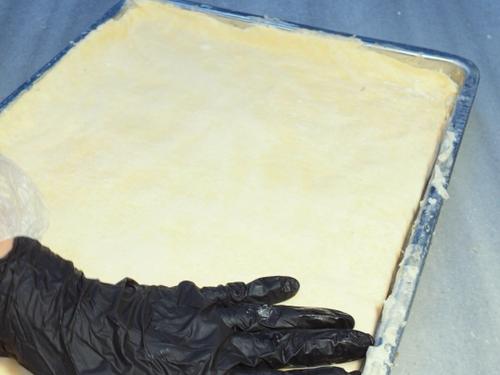
Each sheet of phyllo, brushed with clarified butter and stacked on the one below it, creates a boundary. In the oven, water in the dough turns to steam and pushes those boundaries apart while the butter fries the surfaces and sets them. The result is a stack of very thin, separately crisp planes. That is the texture people mean when they say baklava shatters.
More layers, at the same total thickness, means thinner individual sheets and more boundaries — so more separation and a finer shatter. Fewer, thicker layers fuse more, hold more moisture, and eat dense and chewy. Neither is wrong; they are different products. But at the top of the category, fine shatter is what people are paying for.
Why the number alone is meaningless
A tray with forty thick layers is worse than a tray with thirty very thin ones. Layer count only tells you something in combination with total tray depth, and almost nobody quotes both. Two producers claiming forty layers can be making noticeably different products if one is building a two-centimetre tray and the other a three-centimetre tray.
The second problem is that the number is rarely audited. Counting layers in a finished baklava is possible — you can do it on a clean cut face with good light and patience — but nobody does it routinely, and suppliers know that. A quoted count is a claim about process, and it is worth exactly as much as the rest of the supplier's claims about process.
A tray with forty thick layers is worse than a tray with thirty very thin ones. The count only means something alongside the tray depth, and almost nobody quotes both.
The distribution matters too
Layers are not distributed evenly around the filling. A typical build puts a larger stack underneath, the nut layer, and a larger stack on top, with the exact split varying by the cut being made. The base carries the structural load and absorbs the syrup; the top carries the crust and the colour. Getting the ratio wrong produces a tray that is either soggy underneath or that shatters into fragments when cut.
Butter distribution matters as much as sheet count. A sheet brushed unevenly will fuse to its neighbour in the dry patches, and one fused pair inside a forty-layer stack is a defect you can feel. This is skilled repetitive work, it is why the assembly stage is one of the last to be automated in a serious workshop, and it is the actual reason hand-built trays eat better.
What to ask instead
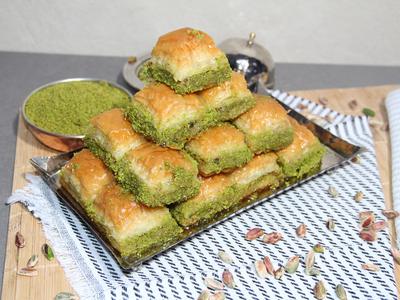
A more useful question than 'how many layers' is 'how thin is the sheet, and is it rolled or machine-drawn'. A better one still is to ask for a cut piece and look at the face yourself. Hold it to the light. You are looking for distinct, separated planes rather than a compressed mass, an even nut seam that runs the full width, and a base that has taken syrup without turning to paste.
Then ask what fat is between those layers, because a hundred layers of margarine is not an achievement. The layer count only earns its reputation when the thing between the layers is butter.
Forty layers per tray is the house standard here, counted on every batch. The figure is only meaningful alongside the tray depth and the fat used, both of which are on every product page.
Hand-rolled against machine-sheeted
A machine produces a sheet of uniform thickness at speed and at low cost. That uniformity is genuinely useful for some products and it is the reason industrial phyllo exists and sells well. What it cannot do is vary — a skilled roller thins the sheet where the tray needs it thinner and leaves body where the structure needs support, reading the dough by feel as they go.
The practical difference shows in how the finished layers behave. Uniform sheets tend to fuse into bands; slightly irregular hand-rolled sheets separate more readily, because the tiny variations create weak points where steam can push through. The shatter people describe in good baklava is a physical consequence of that irregularity.
How to count them yourself
Take a clean cut piece, hold it edge-on under a strong light, and look at the base stack rather than the top. In a well-made tray the layers read as distinct dark and pale lines. Counting is tedious and imprecise, but you do not need an exact number — you need to know whether you are looking at twelve visible planes or forty, and that distinction is obvious within a few seconds.
Do it on a thawed sample rather than a frozen one, and do it on a piece from the middle of the tray. Edge pieces are always better made than centre pieces, for the simple reason that edges are where a baker's attention naturally goes.
Where the number came from
Forty is not a magic figure and no regulation requires it. It is a workshop convention that represents roughly what a skilled roller can produce in a working morning for a standard tray depth, at a thinness that gives good separation without the stack becoming so fragile that it cannot be cut cleanly. Houses that quote sixty or a hundred are usually building deeper trays or using thinner sheets, and both are legitimate.
What matters is that the number is counted rather than claimed. A producer who audits layer count per batch has a process; one who quotes a round figure in a brochure has a marketing line. They are easy to tell apart by asking who does the counting and how often.