 DUKA WORLD
The long, disputed history of a layered pastry
Ottoman palace kitchens, a procession of janissaries, and an argument about origins that nobody is going to win.

Ask where baklava comes from and you will start a fight. The honest answer is that layered pastries filled with nuts and sweetened with honey or syrup appear in several places across the eastern Mediterranean and West Asia over a very long period, and the thing we now recognise as baklava is the product of that whole region rather than any single kitchen in it.
What can be said with more confidence is where the version most of the world eats was refined. The Ottoman palace kitchens at Topkapı developed layered pastry into something close to its modern form, with the sheet pushed thinner and the assembly formalised, and from there it spread through the empire and out of it.
The precursors
Two ancestors are usually proposed. The first is a Central Asian tradition of layering thin bread with fat, carried west by Turkic migration. The second is a Byzantine and earlier Greek tradition of nut-and-honey pastries. Both are plausible, both leave traces, and the argument over which matters more tends to say more about modern national feeling than about medieval baking.
There is a third position, which is that this is the wrong question. Thin dough, nuts and sweetener are not a difficult idea. What is difficult is the specific technique — sheets rolled to translucency, stacked in the dozens, laminated with clarified butter and baked so the layers separate rather than fuse. That technique is what makes baklava baklava, and it developed in a professional kitchen culture with time, staff and money, which points at the palace.

The Baklava Procession
One piece of Ottoman ceremony is worth knowing because it tells you how the pastry was regarded. During Ramadan the palace distributed trays of baklava to the janissary corps, and the collection of those trays became a formal event — the Baklava Alayı, the Baklava Procession. Soldiers carried the trays back to barracks in an organised column.
The detail that matters is what happened when the corps refused the trays. A rejection was not sulking about dessert; it was a recognised signal of disaffection, read by everyone involved as a warning of worse to come. A pastry had become a piece of political vocabulary. That is not a status most sweets achieve.
When the janissaries refused their trays, it was not a complaint about dessert. It was a recognised signal that the corps was no longer content.
The spread
As the empire receded, the pastry stayed. Versions took root across the Balkans, the Levant, the Caucasus and North Africa, each adapting to local ingredients and local sweetness preferences. Walnut dominates where walnut is cheap; pistachio where pistachio grows; almond in parts of the Maghreb. Syrup gives way to honey in some traditions. Rose water and orange blossom appear in the Levant and are largely absent from the Turkish version.
Greek baklava tends to be thicker-cut, spiced with cinnamon and clove, and finished with honey. Levantine versions are often lighter on syrup and perfumed with blossom water. Iranian baklava is frequently smaller, drier and scented with cardamom and rose. None of these is a corruption of the others. They are what happens when a technique travels and meets a different pantry.
Gaziantep
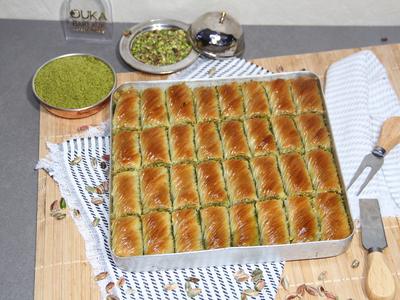
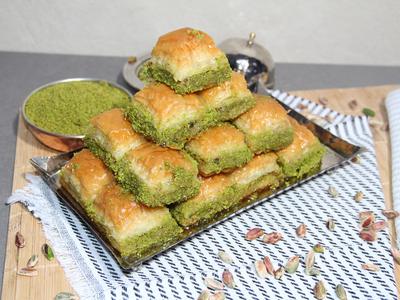
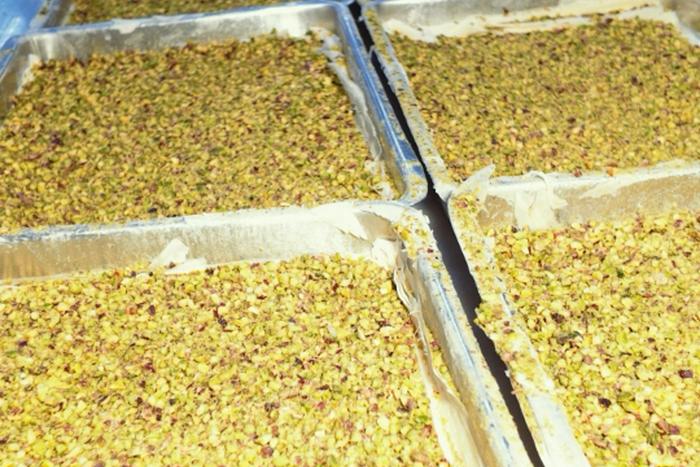
Within Turkey, one city became synonymous with the pastry. Gaziantep, in the southeast, sits in the pistachio-growing belt, and its baklava tradition is built around that proximity — pistachio used generously, sheets rolled exceptionally thin, and a relatively restrained syrup so the nut is not buried. Antep baklava carries protected geographical indication status, which is a legal statement about a defined product made in a defined place to a defined method.
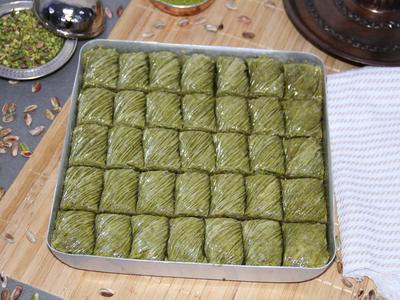
Kahramanmaraş, two hours north, has its own claim, built less on the pistachio and more on the dairy. The Taurus foothills produce the thick clotted cream called kaymak, and the Maraş pastry tradition leans into it: cream-filled şöbiyet, the rolled sarma with a kaymak core, and the cold pistachio-and-cream slabs that barely contain any pastry at all. It is a different emphasis from Antep's, and it is why the two cities' ranges do not look alike.

Why the argument persists
Food origin disputes are rarely about food. They are about who gets to claim a thing that people love, and they intensify when national identities are recent and contested. Baklava sits across several such fault lines at once, which guarantees that any confident single-origin claim will offend somebody.
The commercially useful position is also the historically honest one: this is a regional tradition with deep roots in several places, refined to a high technical standard in Ottoman professional kitchens, and expressed today in dozens of distinct local forms. A producer who tells you their city invented it is selling you something. A producer who can tell you exactly how thin their sheet is, what fat they use and where their pistachio was grown is telling you something more useful.
Protected geographical indication covers a specific named product made to a defined method in a defined area. It is a statement about that product, not a ruling on the history of the wider category.
How the pastry moved
Trade routes carried it as much as armies did. Sugar, nuts and thin dough are all portable knowledge, and the craftsmen who worked in palace and guild kitchens moved between cities in ways that spread technique faster than any cookbook. By the nineteenth century, versions of the pastry were established from the Adriatic to the Caucasus, each one already adapting to what was locally cheap.
Migration did the rest, and is still doing it. Turkish, Greek, Lebanese and Armenian communities carried the pastry into Western Europe, the Americas and Australia in the twentieth century, which is why a world-food aisle in Berlin or Melbourne today carries products that would be recognisable in Gaziantep. The category's export potential outside its home region rests almost entirely on that groundwork.
What changed in the last fifty years
Two things, both technical. Blast freezing turned a pastry with a few days of life into one with a year, which is the single development that made international trade in it possible at scale. Before that, exporting baklava meant either shipping it dry and accepting a compromised product, or not shipping it at all.
The second was the industrialisation of phyllo. Machine-sheeted dough made baklava available at price points the hand-rolled product could never reach, and it split the category in two. That split is now the most important commercial fact about baklava: the two halves compete for different customers, and a producer who tries to sit in the middle usually ends up losing both.
What has not changed is the assembly. Layering a tray by hand remains the step that resists automation most stubbornly, and the workshops that are famous are famous for it. Everything upstream and downstream of that step has been mechanised somewhere; the middle is still people.