 DUKA WORLD
How long does baklava actually last?
Four days, twelve months, or somewhere in between — the honest answer depends entirely on what happened in the first few hours after it left the oven.
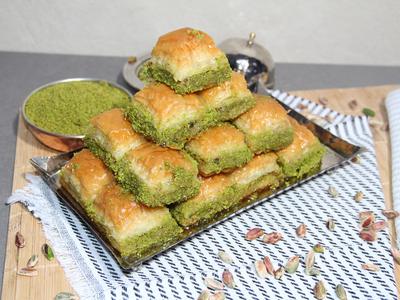
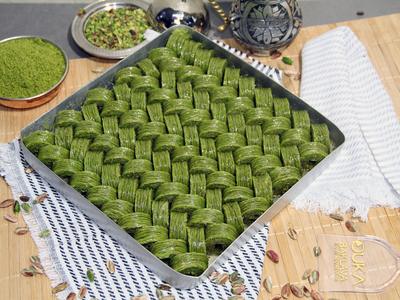
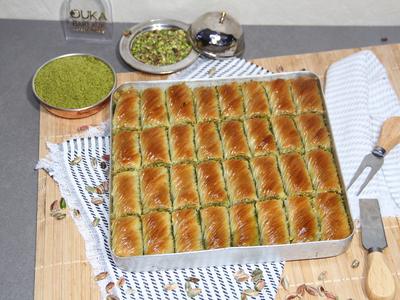
This is the single most asked question about the category, and most of the answers you will find are wrong because they treat baklava as one thing. It is not. A tray of plain baked pistachio baklava, a cream-filled şöbiyet and a cold pistachio slab have different lives, and the same tray has a completely different life depending on how fast it was frozen.
The short version: chilled, four days. Frozen properly, twelve months. Left at room temperature in a shop, a few days at best and dropping fast if the air is humid.
What actually degrades
Three things, in roughly this order. First, the crust takes up moisture — from the syrup below it, from the filling, from the air — and stops being crisp. This is the fastest change and the one customers notice first. Second, the butter oxidises, which dulls the flavour over weeks rather than days. Third, in cream-filled lines, the dairy does what dairy does.
Notice what is not on that list: sugar. The syrup is a preservative, which is why heavily syruped traditional sweets keep as long as they do at ambient temperature. It is also why baklava does not go dangerous quickly; it goes disappointing quickly, which is a commercial problem rather than a safety one.

Why blast freezing changes the answer
Freezing slowly forms large ice crystals that puncture cell structure. When the product thaws, those punctures release water into the pastry and you get a soggy, collapsed tray — which is why home-frozen baklava is usually a disappointment. Blast freezing takes the product through the critical temperature band fast enough that the crystals stay small and the structure survives.
Done within hours of baking, this effectively pauses the product. The crust is still crisp when it goes in, so it is still crisp when it comes out. Twelve months at minus eighteen is a conservative, commercially useful figure rather than a theoretical maximum.
Freezing does not preserve a tired product. It pauses whatever state the product was in when it went in, which is why the hours between oven and freezer decide everything.
Thawing without ruining it
Slowly, in the carton, in a chiller, overnight. The carton matters: it buffers the temperature change and, crucially, it catches the condensation that would otherwise land on the crust. A tray unwrapped and thawed on a counter will sweat, and a wet crust does not come back.
Once thawed, treat it as chilled product with a four-day life. Do not refreeze. Bring plain baklava to room temperature before serving — cold mutes the butter — but serve the cream lines cooler.
What the date on the box means
Frozen pastry carries a best-before date, not a use-by. The distinction is legal and real: best-before is a quality marker, and a product past it is not unsafe, merely no longer guaranteed to eat as intended. Use-by is a safety limit and applies to products where microbial risk grows. Baklava, being sweet, dry-ish and frozen, is firmly in the first category.
For an importer this matters commercially. A best-before date gives you room to clear stock at a discount rather than destroy it, and it means a delayed container is an inconvenience rather than a write-off.
The practical planning numbers
- Frozen at minus eighteen: twelve months from production.
- Chilled at zero to four: four days from thawing.
- At ambient on a counter: hours to a couple of days, depending on humidity — a display problem, not a safety one.
- Refrozen after thawing: do not. The texture will not survive a second cycle.
Those four lines are the whole operational answer, and they are why the category works as an export business at all. A pastry with a four-day life cannot cross an ocean. A pastry with twelve months can sit in a distributor's freezer through a slow quarter and still arrive on a shelf in good condition.
Shelf life figures are the producer's declared values under stated storage conditions. Confirm them against the specification supplied with your pro-forma invoice.
Why ambient shipping usually fails
Buyers regularly ask whether the product can travel without refrigeration, because reefer freight costs meaningfully more. The arithmetic looks attractive until you price the consequences: an ambient shipment arrives with a few days of useful life, which means it has to sell immediately, which means it has to be discounted if it does not.
There is also a quality trap. A tray shipped ambient does not spoil in a way that makes it unsellable; it goes quietly soft, and the customer who buys it forms a view about the product and the brand that no future shipment corrects. The saving on freight is a one-off; the reputational cost is not.
Shelf life by line
- Plain baked baklava: the most robust. Survives the cycle with the least change.
- Rolled and twisted forms: equally robust, and better at surviving physical handling.
- Kadayif: holds its crunch longest of anything in the range.
- Closed cream forms: good, because the pastry shields the filling.
- Open cream forms and cold uncooked pieces: the most demanding. Specify these only where the chain is known to be reliable.
What to tell a retail customer
Keep it simple and truthful: bring plain baklava to room temperature before serving, keep cream lines cool, do not refreeze, and eat within four days of thawing. Most disappointment at the consumer end comes from serving it cold straight from a fridge, which mutes the butter and makes even an excellent tray taste ordinary.
If you are packing for e-commerce, say it on the insert rather than only on the pack. The instruction that arrives with the box is the one that gets read.
Labelling dates, and which one you need
Frozen confectionery normally carries a best-before rather than a use-by, because the risk is quality loss rather than safety. The distinction matters commercially: a best-before date can be sold up to and, in many markets, after, whereas a use-by cannot. Getting this wrong on a first label costs a relabelling exercise at the destination.
Whatever date you print, it must be justified by evidence — shelf-life trials or a documented rationale — and it must be the date for the product as the consumer will hold it, not as the freezer holds it. Include the thawed window explicitly, because that is where the real limit sits.